Alloys 7 min read
Aluminum die casting: alloys, cold chamber and where it fits
By Inytialgo ·
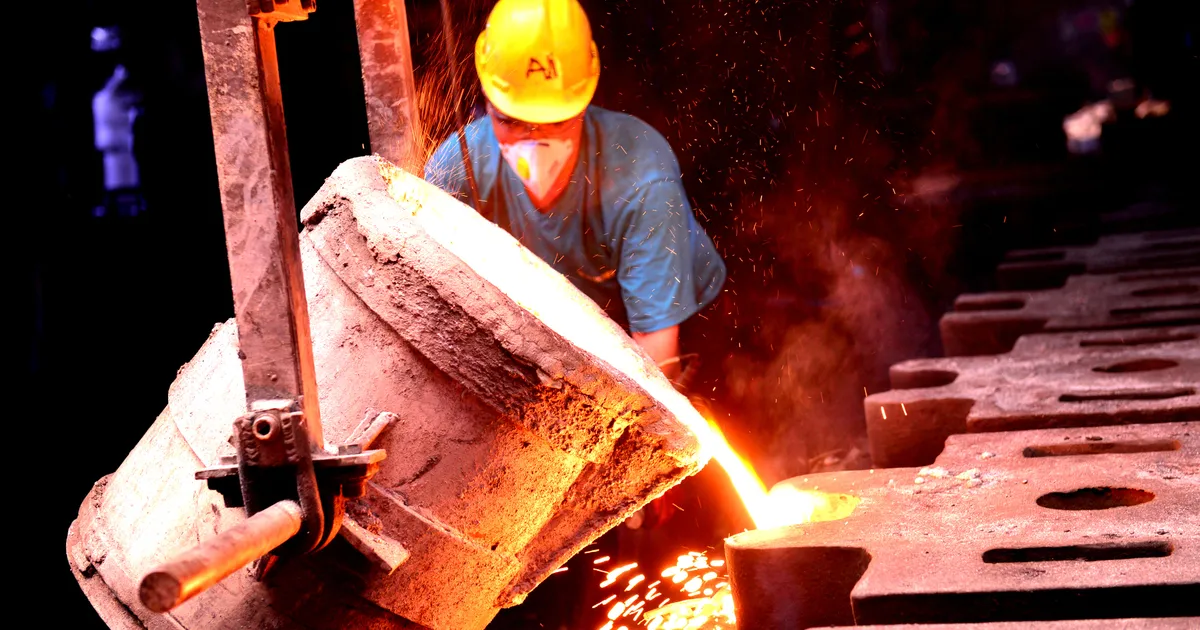
Aluminum is the default for die cast parts that have to carry load, move heat or stay light — and the reason it behaves nothing like zinc on the floor comes down to one number. Aluminum melts near 660 °C. That is hot enough to attack a steel plunger sitting permanently in the melt, which is why aluminum runs in a cold chamber machine and zinc does not.
Everything else — cycle time, die life, porosity, what your tooling costs to maintain — follows from that single constraint.
What is die cast aluminum?
Die cast aluminum is not pure aluminum. It is an aluminum alloy, almost always with silicon as the main addition and usually some copper, injected into a steel die at high pressure and solidified in seconds.
The silicon is what makes the alloy castable: it improves flow into thin sections and reduces shrinkage as the part solidifies. The copper adds strength and machinability, and charges for it in corrosion resistance. That trade — flow and strength against corrosion and ductility — is the whole conversation when someone asks which grade to use.
What you get is a part with good strength for its weight, decent thermal and electrical conductivity, and geometry that would be expensive to reach any other way. What you do not get, unless the process is built for it, is a part you can heat treat or weld without thinking twice. More on that below.
Why aluminum runs cold chamber
In a hot chamber machine the injection system sits inside the molten metal. That works beautifully for zinc, whose melting point is low enough to leave the steel alone. Aluminum at casting temperature would erode that hardware and pick up iron from it, contaminating the melt.
So aluminum uses a cold chamber cell: metal is dosed from a separate furnace into the shot sleeve for each cycle, then pushed by the plunger. The practical consequences are the ones you feel in production:
- Longer cycles. Dosing is an extra step, and the shot sleeve fills only partially, which affects how the metal behaves in first phase.
- Air is a bigger problem. A partially filled sleeve carries air that the shot can drag into the cavity. Venting, overflows and first-phase profile stop being details.
- Shorter die life. Aluminum is hotter and more aggressive against the die surface than zinc: soldering, heat checking and washout show up sooner.
If your part is small, highly detailed and does not need aluminum’s mechanical properties, this is exactly the point where zinc deserves a look. We compared that family in Zamak alloys.
The alloys that matter: A380, ADC12 and AlSi9Cu3
Three designations dominate the conversation, and much of the confusion comes from treating them as regional names for one alloy. All three are Al-Si-Cu alloys, but the cross-references are not one to one: NADCA’s Product Specification Standards for Die Castings (2021, tables 3-1 and 3-17) pairs A380 with JIS ADC10 and EN AC-46500, and pairs ADC12 with 383 and EN AC-46100. AlSi9Cu3(Fe) is EN AC-46000 under EN 1706, a separate European grade:
| Designation | Standard family | Where you meet it |
|---|---|---|
| A380 | North American | The workhorse of the Americas |
| ADC12 | Japanese | Common in Asian supply chains and Japanese OEM prints |
| AlSi9Cu3 | European (EN) | Standard on European drawings |
They are not interchangeable line for line — the specification ranges differ, and so can the impurity limits your customer will accept — but they occupy the same slot: general purpose, good castability, good strength, acceptable cost.
When a part needs more than that, the family changes rather than the grade:
- Better corrosion resistance or ductility usually means moving to an Al-Si alloy with little or no copper.
- Structural parts that will be heat treated or welded need alloys developed for it, and a process that keeps entrapped gas low enough for the part to survive the treatment.
That last point is where most disappointment comes from, so it deserves its own section.
What aluminum gives you, and what it charges for
It gives you: strength-to-weight, thermal conductivity, dimensional stability, and the ability to replace an assembly of several parts with one casting. It is also fully recyclable, and remelt is a normal part of the economics rather than an afterthought.
It charges you in porosity. High pressure die casting fills the cavity in milliseconds. Any air, steam or gas from the release agent that does not leave the cavity stays inside the part. Normally that porosity is cosmetic and irrelevant. It stops being irrelevant when the part must be pressure tight, must be welded, or must go through a solution heat treatment — where trapped gas expands and blisters the surface.
The fix is not a better alloy. It is a process built to evacuate the cavity: vacuum assistance, venting and overflow design, a first-phase profile that does not entrain air in the sleeve, and a release agent applied in the amount the part needs and no more. Where those parts land — structural, thin walled, weldable — is the ground covered by the die casting process.
What aluminum die casting demands from the cell
Aluminum punishes an unbalanced cell more than zinc does. The items that decide whether a program runs or fights you every shift:
- Thermal management of the die. Cooling channels, spray timing and cycle discipline. A die that runs hot solders; a die that runs cold gives you cold shuts and short fills.
- Gate and runner design. Where the metal enters, how fast, and where the last air goes. This is decided in simulation, before steel is cut, or paid for in tryout.
- Second phase and intensification. How the machine switches from filling to packing, and how much pressure it holds while the part solidifies.
- Melt quality. Degassing and cleanliness. Hydrogen in the melt becomes porosity in the part, and no gate design compensates for it.
- Die material and surface. Hot work tool steel, correctly heat treated and maintained, because the failure modes here are cumulative.
None of these are exotic. They are simply the ones that get skipped when a program is quoted on part price alone.
Where aluminum parts actually show up
The families are consistent across industries, and they share a logic: a part that has to be light, dissipate heat, or replace a bolted assembly.
- Powertrain and e-mobility: housings, covers, brackets, and increasingly battery and inverter enclosures where the casting also carries heat away.
- Structural body parts: the large thin-walled castings that consolidate dozens of stampings into one piece.
- Electronics and telecom: enclosures and heat sinks, where conductivity and EMI shielding both matter.
- Industrial and consumer hardware: pump and valve bodies, tool housings, lighting fixtures.
The common thread is volume. Die casting tooling is expensive and durable: the question is rarely whether aluminum can make the part, but whether the program runs long enough to pay for the die.
Where to start if you are evaluating aluminum
Before choosing a grade, get three things on the table:
- What the part has to survive. Pressure tightness, welding, heat treatment or none of the above. This decides the alloy family and whether you need vacuum, long before it decides the designation.
- Wall thickness and geometry. Thin walls need flow; thick sections need a feeding strategy. Both are cheaper to solve on screen than in tryout.
- Annual volume and part life. The tooling investment only makes sense against a real production horizon.
With those answers, the alloy choice is usually short. Without them, it is a guess dressed as a specification — and the tryout is where guesses get billed.
If you want the filling and solidification behavior checked before the die is cut, that is what casting simulation is for, and it is the cheapest place to be wrong.
- #aluminum die casting
- #alloys
- #cold chamber
- #A380
Found this useful? Add Inytialgo as a preferred source and you'll see our posts more often in your Google Search.
Add as a preferred source on Google