Process 6 min read
Giga press: what it is, how it works and what it takes to run one
By Inytialgo ·
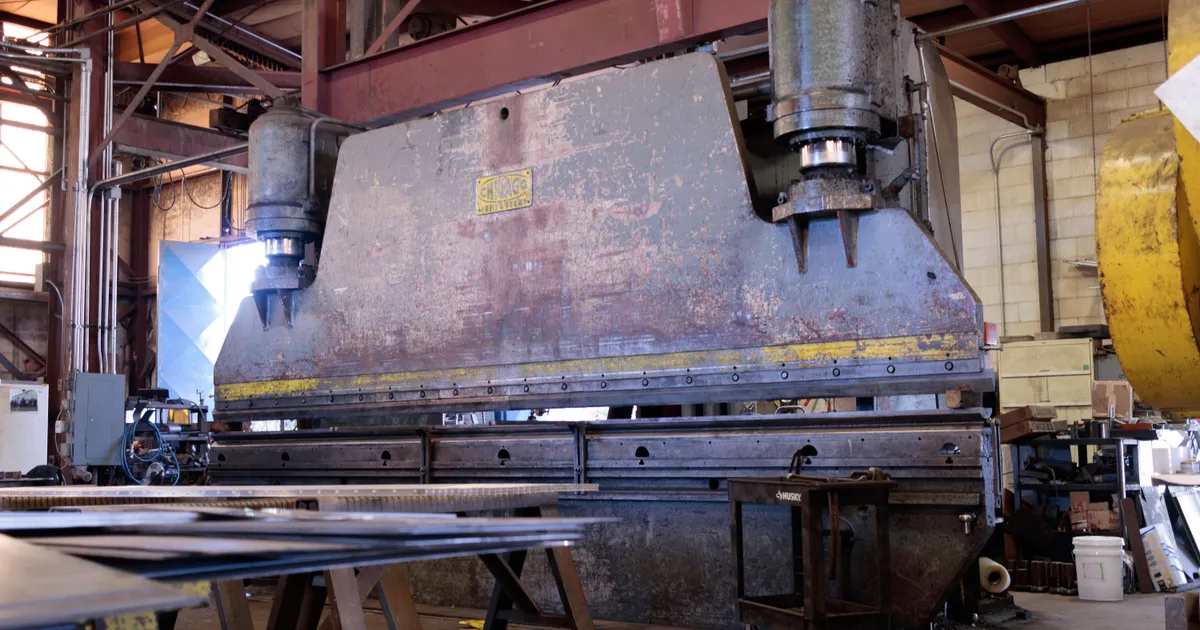
A giga press is a high pressure die casting machine with clamping force in the thousands-of-tonnes class, built to cast a single structural part large enough to replace a welded subassembly. Architecturally it is a cold chamber machine like any other — two platens, tie bars, a shot sleeve and a plunger. What makes it a different animal is not a new principle. It is scale, and everything scale breaks.
The name is industry shorthand, not a specification. It arrived with the first installations casting single-piece vehicle body sections and stuck. Nobody certifies a machine as “the giga press”: you read its clamping force, its shot capacity and its platen size, exactly as you would with a 400 tonne machine.
What is a giga press?
It is the equipment half of gigacasting. The part strategy — integrating functions so one casting absorbs an assembly — is covered in gigacasting explained. This article is about the machine that has to deliver it.
Three things define one:
- Clamping force, sized the usual way: projected area on the parting plane multiplied by cavity pressure, plus margin. The arithmetic is identical to a small machine, as set out in die casting machine types and tonnage. Only the answer is unusual.
- Shot capacity, because a part of this size needs a shot weight measured in tens of kilograms, delivered inside the same few tens of milliseconds a small part gets.
- Platen and daylight, which set how large a die the machine can physically hold and how a part that size gets out of it.
Everything else people find remarkable about these machines — the foundation, the crane, the extraction robot — follows from those three.
How does a giga press work?
The cycle is the standard die casting sequence, with each step stretched to its limit.
- Close and lock. The clamping unit holds the die shut against injection pressure across a very large projected area. Platen deflection, which is a rounding error on a small machine, becomes a real flatness problem here: if the platen bows, the die opens at the center and flashes.
- Dose and ladle. Metal is transferred into a horizontal shot sleeve. Aluminum leaves no alternative to cold chamber — a submerged assembly would not survive its working temperature, as explained in aluminum die casting.
- Evacuate. The cavity and runner are pulled down through vacuum valves before and during filling. At this scale it is not an upgrade, it is a precondition: without it the part cannot be heat treated or welded.
- Inject. Slow first phase to fill the sleeve without wave-breaking, a switch point, a fast second phase and intensification. The filling window on a large thin cavity is narrow, and the shot curve has to be repeatable rather than merely correct once.
- Solidify and eject. Ejection forces are distributed across a huge thin part that is easy to distort on the way out. The ejector layout is a structural design exercise, not a detail.
- Extract, quench, trim. The part is too large and too hot to be handled by anything but automation, and flatness out of the die usually needs a post-forming step before a body shop will take it.
Why scale changes everything
The failure modes of a giga press are not the failure modes of a big small machine. Four of them are worth knowing before anyone quotes one.
The die is a logistics problem. Changing, servicing or storing a die of this size involves crane capacity, floor loading and a bay that exists for that purpose. Downtime is not measured in the hours the repair takes but in the hours the handling takes.
Thermal management stops being local. A die this large does not reach a stable thermal state quickly, and the temperature map across it is never uniform. Cooling circuits, cycle time and the first shots after any stoppage matter far more than on a compact die.
Dosing consistency becomes a first-order variable. A few percent variation in shot weight is absorbed by a small part. Spread across a large thin cavity, it moves the switch point and the fill pattern.
Yield is the business case. A scrap rate that a conventional cell would live with can invert the economics here, because every reject carries tens of kilograms of aluminum, a full cycle of the most expensive asset on the floor and whatever downstream operations had already been performed on it.
The cell, not the machine
Buying a giga press is buying a line. The press dictates a foundation, a bay height, a crane, an extraction robot with reach, a quench station, a trim press sized to the part, and storage for parts that no longer fit in a tote. Melt supply has to keep up with shot weights that empty a furnace faster than a conventional cell does, and vacuum capacity has to be sized for the volume being evacuated in the time available.
Because one machine carries a large fraction of a vehicle, redundancy that used to be spread across a body shop is now concentrated. Planned maintenance stops being a scheduling preference and becomes a production strategy.
What it takes to run one well
Nothing on this list is exotic. All of it is the ordinary discipline of high pressure die casting, applied without slack:
- Metal quality. Degassing and cleanliness matter more, not less. Vacuum removes entrapped air; it does nothing about dissolved hydrogen or oxides.
- A shot curve that repeats. Closed-loop control and a documented, measured curve — not the one on the process sheet from two years ago.
- Vacuum treated as a process variable. Level logged per shot, with an alarm threshold. Vacuum systems degrade silently: a tired seal or a fouled valve shows up as scrap long before anyone suspects the valve.
- Die maintenance on a calendar. Soldering, erosion around the gates and ejector wear are all cheaper to schedule than to discover.
- A filling strategy decided before the steel is cut. On a die this expensive, moving a gate or a vent after machining is not a correction, it is a project.
Do you need a giga press?
Almost certainly not, and that is fine. Very few plants will ever run one, and the machine is the least transferable part of the story.
What does transfer is the requirement set it normalised: vacuum-assisted injection, higher-elongation alloys, thin walls across large surfaces, and structural parts expected to survive heat treatment and welding. Those are turning up at perfectly ordinary tonnages, in battery trays, enclosures and telecom and datacenter hardware. The bar the giga press raised is now being applied to parts you already make.
Meeting it starts on the model, not on the shop floor: gate and vent layout, vacuum connection point, wall thickness distribution and the thermal balance of the die after several cycles. That is what our simulation software is for, and where our consulting begins when a structural part is heading into territory the plant has not run before. The vacuum equipment and cell periphery come afterwards — once you know where the air is trapped, not before.
- #giga press
- #gigacasting
- #die casting machine
- #clamping force
- #HPDC