Process 7 min read
Gigacasting explained: what it is, why carmakers do it and the trade-offs
By Inytialgo ·
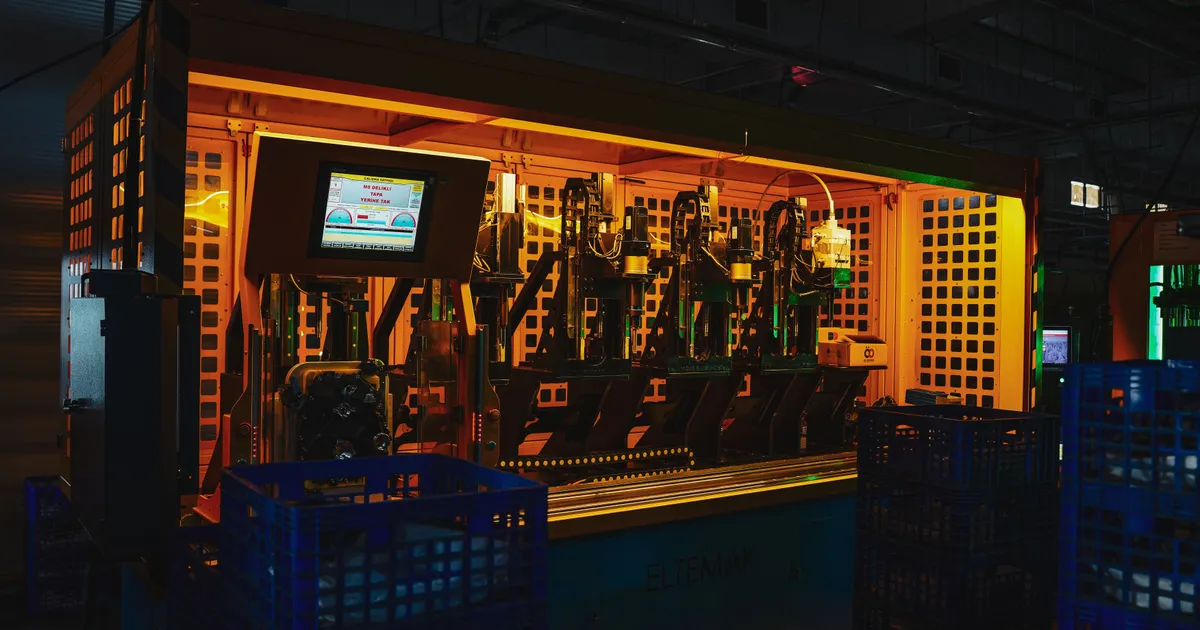
Gigacasting is high pressure die casting applied at a scale where a single shot replaces an assembly that used to be dozens of stamped and welded parts. The process is the one you already know — molten aluminum injected into a steel die at high speed — but the part is a structural section of a vehicle body, and everything around it changes because of that: the machine, the alloy, the die, the handling and, above all, the cost of a reject.
That last point is the one worth front-loading. In conventional die casting a scrapped part costs you a kilo of metal and a cycle. In gigacasting it costs tens of kilos of aluminum, a cycle on a machine that cost what a small plant costs, and often downstream operations you had already paid for. The economics are not a scaled-up version of the old ones. They are different economics.
What is gigacasting?
Gigacasting is the practice of casting very large, thin-walled structural parts in one piece, on machines with clamping force in the several-thousand-tonne class, to absorb what was previously a multi-part welded subassembly.
The gigacasting definition that matters in a plant is not about size in millimeters. It is about function integration: the casting no longer replaces one component, it swallows the components attached to it. A rear floor, a front structure, a battery enclosure frame — parts whose topological boundaries used to be set by what a press could stamp and a robot could weld.
That is also why the term keeps moving. Nothing about the physics changes at a particular tonnage; what changes is how much of the vehicle a single die is asked to contain.
Megacasting vs gigacasting: is there a difference?
In practice the two words are used interchangeably, and neither has a standards body behind it. Where a distinction is drawn, megacasting tends to describe the general move toward large structural castings and gigacasting the extreme end of it, on the largest machines currently in service.
Treat both as marketing shorthand for the same engineering shift and read the specification instead: projected area on the parting plane, wall thickness, alloy and whether the part is heat treated. Those four tell you what you are dealing with. The prefix does not. The spelling wobbles for the same reason: you will see giga casting and giga-casting in print alongside the single word — this article uses gigacasting, and all three name the same practice.
The gigacasting process, step by step
The sequence is recognizable — it is still the die casting process — but each stage carries requirements that a small part never imposes.
- Melt and dose. Large shot weights make dosing consistency a first-order variable rather than a housekeeping detail. Metal quality matters more here, not less: a hydrogen-loaded bath ruins an expensive part instead of a cheap one.
- Inject. First phase, switch point and intensification on a shot that has to fill a very large, thin cavity before the front goes pasty. The filling window is narrow and it does not forgive an approximate shot curve.
- Evacuate. High vacuum is not optional at this scale. Gas porosity is what blocks heat treatment and welding, and a structural part is defined by surviving both.
- Solidify and eject. Ejection forces on a large thin part are high enough that the die’s ejection layout becomes a structural design problem in its own right.
- Trim, straighten, inspect. Flatness out of the die is rarely good enough for a body shop, so post-forming is part of the process rather than a rescue operation.
Two enabling technologies sit underneath all of it: higher-elongation alloys, so the part can be joined and deform without cracking, and vacuum assistance, so the metal is sound enough to justify the alloy. Some programs add a third, heat-treatment-free alloy chemistry, precisely to remove the distortion that a furnace introduces into a part this large.
The gigacasting machine and the cell around it
A gigacasting machine is a cold chamber die casting machine — aluminum leaves no other option — sized by the same arithmetic as any other: projected area times cavity pressure, plus margin. The logic is unchanged and is worked through in die casting machine types and tonnage; what changes is that the answer lands in the thousands of tonnes.
At that point the press stops being a machine you install and becomes a plant you build around. The die alone is a handling problem. Extraction, quenching, trimming and storage all need floor space proportional to the part, and the whole line runs at the pace of one machine. The equipment side of this is worth its own read: what a giga press actually is covers the press itself, its architecture and what it takes to run one.
The furnace side scales with everything else. Gigacasting furnaces are not exotic equipment, but the arithmetic is demanding: shot weights in the tens of kilograms empty a holding furnace far faster than a conventional cell does, so melting capacity, holding volume and the dosing system have to be sized as a chain, not bought as line items. And metal quality has to survive that throughput — degassing and cleanliness discipline matter more on a part this expensive, not less.
Who is doing it, and why it spread
Gigacasting entered the mainstream conversation through electric vehicle manufacturing, where the incentives line up unusually well: battery mass makes every kilogram of structure expensive, platforms are new enough to be designed around the process rather than retrofitted to it, and body shop floor space and capital are the constraint being attacked.
Most large automakers have publicly signaled interest in large structural castings since then, with programs at different stages of commitment. Rather than track announcements, watch two signals that tell you whether a program is real: whether the design releases thin-wall structural parts, and whether the supply chain is investing in vacuum and alloy capability. Those two move before the press order does.
What gigacasting trades away
This is the part that gets left out of the business case, and the part a foundry engineer sees first.
- Reject cost. Yield is no longer a quality metric, it is the business case. A modest scrap rate that would be tolerable on a small part can invert the economics of a giga part.
- Repairability. A single-piece structure has no bolted interface to separate at. Damage that used to mean replacing a section can mean replacing far more, which is why gigacasting repair procedures and their insurance consequences became a live discussion almost as soon as the parts hit the road.
- Design flexibility. Function integration freezes decisions early. A die this size is not a component you revise between model years on a whim.
- Concentrated risk. One machine, one die, one part number, and a large fraction of the vehicle behind it. Redundancy that used to be spread across a body shop is now a single point.
None of these is an argument against the technology. They are the reasons the process rewards discipline — in metal, in vacuum and in the filling strategy — far more than a conventional part does.
What it means if you are not building cars
Most plants will never run a giga press, and the interesting part of this story is not the press. It is that the requirements gigacasting made routine — vacuum-assisted injection, higher-elongation alloys, thin walls over large surfaces, structural parts that must survive heat treatment — are now arriving in enclosures, battery trays, datacenter hardware and telecom housings at ordinary tonnages.
That is where aluminum die casting practice is moving for everyone else: not bigger parts, but the same soundness expectations on parts you already make.
The way to prepare for that is unglamorous and starts before any steel is cut: decide the filling strategy, the vent and vacuum layout and the wall thickness distribution on the model. That is what our simulation software is for, and where our consulting work starts when a structural part is heading into uncertain territory. On a part this expensive, the cheapest correction is still the one made while the die is a file.
- #gigacasting
- #megacasting
- #structural casting
- #HPDC
- #vacuum