Process 11 min read
Automotive die casting: which parts, which alloys and what OEMs demand
By Inytialgo ·
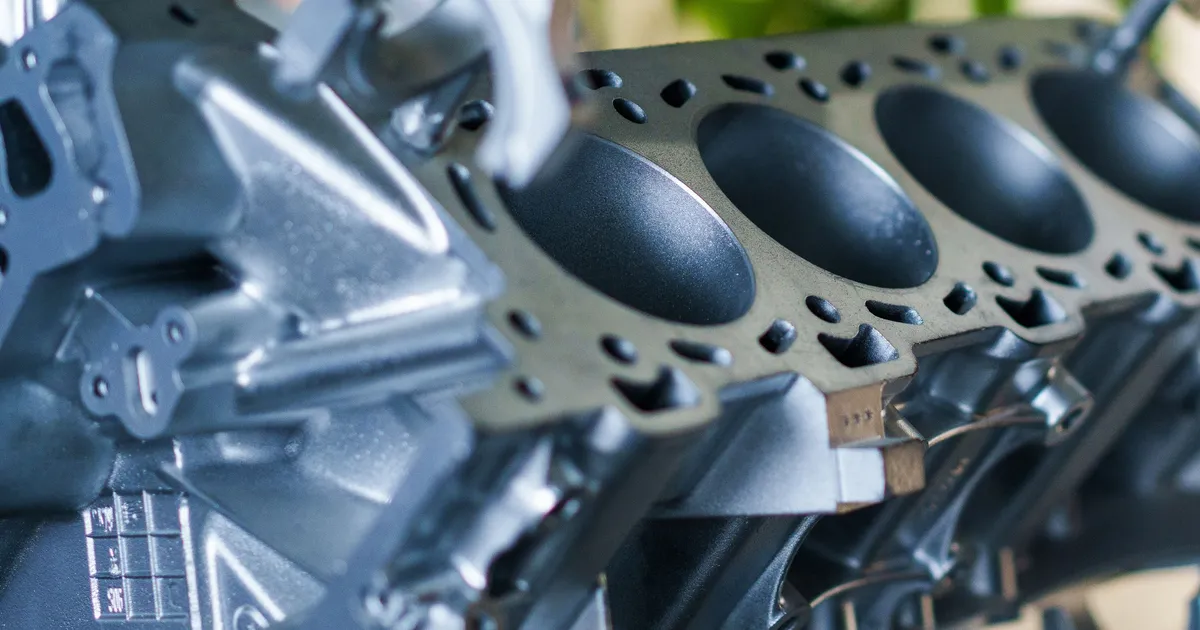
Automotive die casting is high pressure die casting (HPDC) applied to car parts: transmission and clutch housings, engine and e-motor housings, brackets, structural nodes, battery housings and a long list of small zinc parts. The process is the one any die caster knows. What changes in die casting for the automotive industry is the customer, who moves part of its own production risk onto the die caster through porosity limits, die life commitments and payment tied to PPAP approval.
That is why an automotive program is won or lost before the first shot, in what the die caster accepts on paper and writes into the die specification. Parts, alloys, machine size and requirements follow, with a worked example you can redo with your own numbers.
Which car parts are die cast?
Most of them share one logic: a part that must be light, carry load or heat, and replace an assembly of several machined or welded pieces. By family:
| Part family | Typical examples | Usual alloy family |
|---|---|---|
| Powertrain | Transmission cases, clutch housings, oil pans, engine blocks, covers | Aluminum (Al-Si-Cu) |
| Chassis and body structure | Shock towers, nodes, longitudinal members, large underbody castings | Low-iron aluminum for structural use |
| Electric drive | E-motor housings, inverter housings, battery housings | Aluminum |
| Interior and small mechanisms | Lock housings, sensor housings, brackets, decorative trim | Zinc (Zamak) |
| Lightweight frames | Instrument panel beams, seat frames, steering wheel cores | Magnesium |
Engine blocks deserve a note: blocks are made by several casting routes, and an open-deck aluminum block is the type that fits high pressure die casting. The route is decided by the design of the block, not by habit.
Why carmakers keep choosing die casting
Die casting gives net-shape parts with thin walls, cast-in bosses and ribs, and a cycle measured in seconds. The trade-off is fixed: an expensive steel die that only pays off over a long program, and porosity that the process has to be built to control.
The volume of aluminum in cars keeps that trade-off on the table. In its 2023 North American Light Vehicle Aluminum Content and Outlook, carried out by Ducker Carlisle and released on April 10, 2023, the Aluminum Association says that castings remain the largest aluminum product form, but that their growth is limited because powertrain and transmission components are being replaced by e-drives, battery housings and high-voltage devices. The same study expects battery electric light trucks to average 644 pounds of aluminum content by 2030.
For a die caster, that sentence is the market map: fewer transmission cases over time and more e-motor, inverter and battery housings, each with its own sealing and thermal requirements.
Which alloys does automotive die casting use?
Aluminum is the family behind the castings that study counts. General-purpose Al-Si-Cu alloys such as A380, ADC12 and AlSi9Cu3 cover housings and covers; we compared them in aluminum die casting. Structural parts that must deform before they crack, be welded or go through heat treatment use low-iron aluminum alloys developed for that job, and a process built to keep entrapped gas low, usually with vacuum assistance.
Zinc runs in hot chamber machines and fills thinner, more detailed sections than aluminum, which is why it shows up in locks, mechanisms and trim. The grades and where they fit are in Zamak alloys.
Magnesium is the lightest of the three and is used where weight matters most in large, thin frames.
The alloy choice follows from what the part has to survive: pressure tightness, a crash load, welding or a heat treatment. The designation comes after that.
What does the automotive customer ask the die caster?
Our founder described the pattern in a 2021 article on our Spanish blog: the automotive customer increasingly asks the die caster or the die maker for conditions that used to be negotiated separately, such as producing the same part in 6 cavities instead of 4 without porosity going up, guaranteeing 150,000 shots of die life, or not getting paid until the part is approved in the PPAP. They are not whims. They are the way the customer moves part of its own production risk onto the tooling supplier.
In a project where die caster and customer genuinely cooperate, those demands are perfectly manageable for whoever masters the craft. For whoever accepts them without fully understanding how that die will actually be used in the plant, they are a blind bet.
The way out is to translate every part requirement into a die requirement, in writing, before the steel is machined. Typical pairs:
| Part requirement | What it asks of the die |
|---|---|
| Porosity level in the part | Vacuum |
| Porosity level in the part | Localized cooling, with minimal release agent |
| Porosity in threaded or machined areas | Localized pulsed cooling |
| Die life | Premium materials, heat treatments and coatings |
| Die life | Pressure and temperature monitoring in the cavities |
| Part flatness | Extended ejector guiding |
| Tight dimensional tolerances | Accurate centering between fixed and moving halves |
We recommend doing this before signing a cavitation or a die life figure, because that is the last moment when an unfeasible requirement can be renegotiated with the customer at no cost. After the die is built, the same conversation is paid for in tryout.
What the die itself costs and what shortens its life is covered in die cast tooling.
Porosity, leak tightness and X-ray: how acceptance gets written
Zero porosity does not exist in high pressure die casting. What exists is an acceptance criterion, and the automotive drawing is where it gets fixed. Three things to check in it:
- Where porosity matters. Sealing faces, threads and machined surfaces matter; a thick boss that is never machined usually does not. A criterion that applies to the whole part costs more than one that applies to its critical zones.
- What reference is used for X-ray. ASTM E505-22 provides film reference radiographs for aluminum and magnesium die castings, with three categories of discontinuities for each alloy, each illustrated in four levels of progressively increasing severity (for digital X-ray, the same standard points to ASTM E2973). A drawing that cites a category and a level is something both sides can measure; “free of porosity” is not.
- How leak tightness is tested. A leak specification is complete when it states the leak rate, the test pressure and the test time. Housings for e-motors, inverters and transmissions are usually checked this way.
The process answer to tight porosity limits is the same in every case: evacuate the cavity. Our approach to it, with a single suction point located through filling simulation, is described in vacuum-assisted die casting.
How big a machine does a car part need?
Clamping force comes out of the part, not out of a catalogue: the projected area on the parting plane (part, runners and overflows) multiplied by the metal pressure you intend to work with. The general method is in die casting machine types and tonnage.
A worked example with a published case. In LEAN HPDC with limited clamping force, a part with 1,400 cm² of projected area was cast with the metal pressure capped at 370 bar, with no intensification:
- 370 bar is 37 N/mm², and 1,400 cm² is 140,000 mm².
- Opening force: 140,000 × 37 = 5,180,000 N, that is 5,180 kN.
- In tonnes-force: 5,180 ÷ 9.807 = about 528 t.
The 580-tonne machine covers that with margin, on a project the industry had sized for 900 tonnes.

Redo the same multiplication with other pressures and the machine class changes:
| Metal pressure on 1,400 cm² | Opening force | Machine class |
|---|---|---|
| 370 bar | about 528 t | 580 t, as in the case |
| 600 bar | about 857 t | 900 t class |
| 800 bar | about 1,142 t | Above 1,100 t |
Read the other way, 900 tonnes on 1,400 cm² corresponds to about 630 bar before any margin. For an automotive quote this matters twice: the pressure you plan decides the machine you need, and the porosity criterion decides the pressure you plan. Both go into the same feasibility review.

Electric vehicles: what changes in the castings
Battery housings and e-motors and drives are among the key components for aluminum growth in electric vehicles between 2022 and 2030, according to the same Aluminum Association study. Cast e-motor, inverter and battery housings differ from a classic powertrain casting in three ways:
- Many are wide, flat parts. A wide, thin housing needs a filling pattern that reaches the last corner before the metal freezes, and a die that does not distort it at ejection.
- They seal coolant or protect electronics. That brings back the leak test and the porosity criterion of the previous section, often on most of the part.
- They carry heat. Wall thickness, ribs and the cooling channels around them are thermal decisions as much as structural ones.
Wall thickness, draft and sealing rules for housings are in die cast aluminum enclosure design. The very large single-piece body castings are a different strategy, covered in gigacasting explained.
Mexico and nearshoring
Mexico is a die casting country built around the car. EUROGUSS, the die casting trade fair run by NürnbergMesse, reported on January 16, 2025 that Mexico holds an estimated 6% of the global die casting market share, and that the automotive industry represents 63% of die casting applications there. The same report names Nemak and Bocar as the two large companies, alongside approximately 100 smaller foundries.

For a plant in Monterrey, Saltillo, Querétaro or the Bajío quoting automotive castings for North American programs, the requirements are the ones in this guide, in English on the drawing and in Spanish on the floor. We work with those plants in Spanish: reports, training, review of simulations and support.
Where to start before quoting an automotive program
Before you commit to cavities, die life or a payment milestone, check three things:
- The part requirements, translated into the die specification. Porosity by zone, leak test conditions, flatness and die life, each with the die feature that answers it.
- The filling and solidification of the part, on screen. Where the last air goes, where the metal freezes first and which zones need localized cooling. That is what casting simulation software is for. We distribute Simcenter Inspire Cast (formerly Altair Inspire Cast) from Siemens Digital Industries Software; the details are on the Simcenter Inspire Cast page.
- The machine against the pressure you need. Projected area times metal pressure, with the margin your process demands.
For a first proposal on a part that already runs with a defect, we ask for the drawing or the 3D of the part, the alloy, the tonnage of the machine and a description of the defect with photos. Our die casting consulting starts from those four inputs.
- #automotive die casting
- #HPDC
- #automotive castings
- #PPAP
- #porosity
Found this useful? Add Inytialgo as a preferred source and you'll see our posts more often in your Google Search.
Add as a preferred source on Google